
How to Rotate Tires on a 4-Wheel Drive Truck
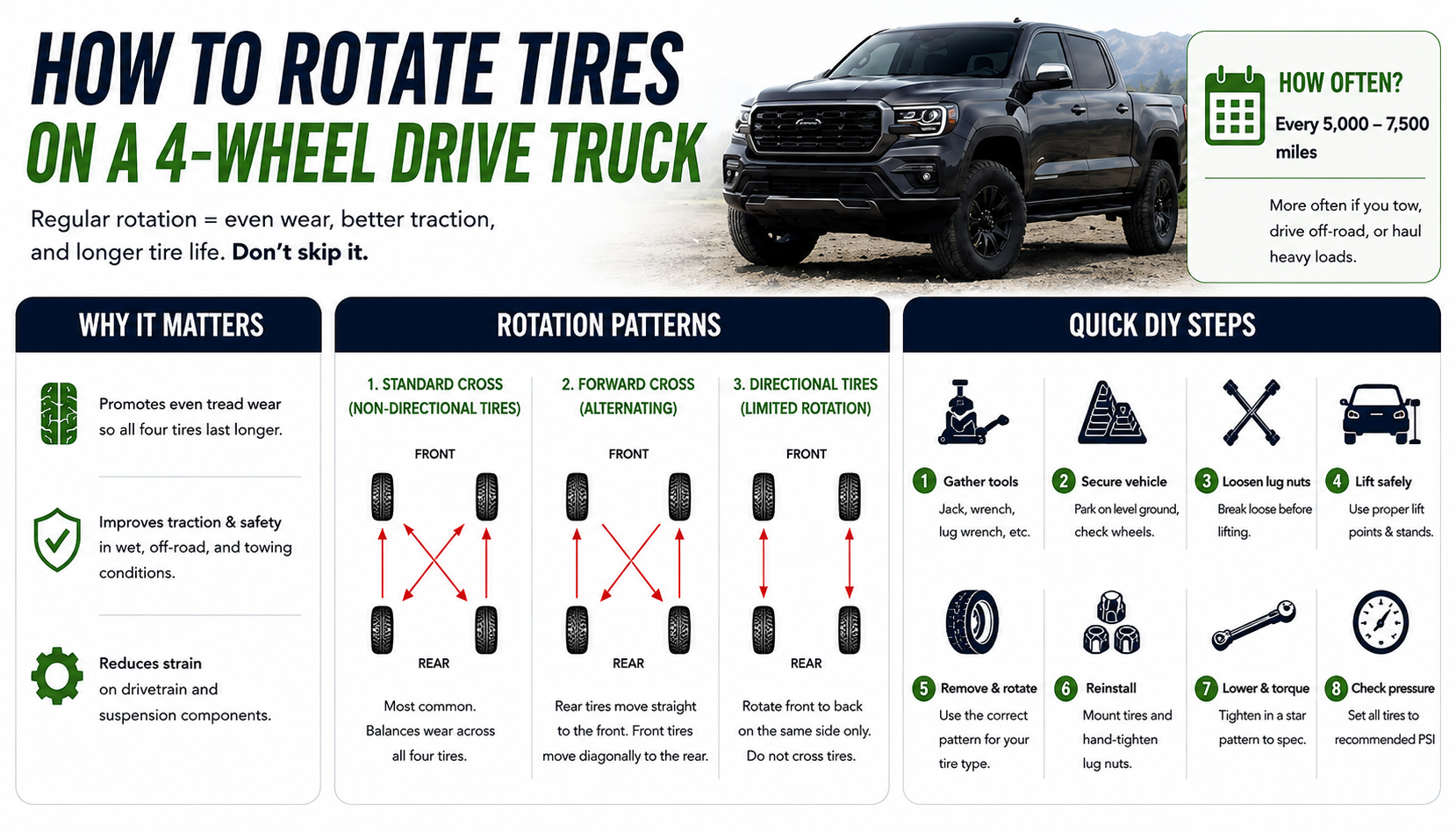
Truck owners put more load, torque, and stress on their tires than the average driver. Between towing, off-road use, and uneven weight distribution, tire wear occurs faster and is often less even. That’s why understanding how to rotate tires on a 4-wheel drive truck isn’t optional. It’s a core part of maintaining traction, extending tire life, and avoiding premature replacement.
At a professional tire shop in Demopolis, tire rotation is one of the most common and valuable services for truck owners. But knowing how it works (and when to do it yourself vs. bringing it in) gives you a real advantage.
Why Tire Rotation Matters on 4WD Trucks
A 4WD system distributes power across all four wheels, but that doesn’t mean all tires wear evenly.
Front tires typically:
- Handle steering forces
- Carry more engine weight
- Wear faster on the outer edges
Rear tires:
- Carry load weight (especially when towing or hauling)
- Wear differently depending on drivetrain behavior
Without regular tire rotation, you end up with:
- Uneven tread depth
Reduced traction (especially in wet or off-road conditions)
- Increased strain on drivetrain components
- Shortened tire lifespan
For truck owners, this directly translates to higher operating costs and reduced performance.
Recommended Tire Rotation Patterns for 4WD Trucks
Not all rotation patterns are the same. The correct method depends on your tire type and whether they are directional or non-directional.
-
Standard Cross Rotation (Non-Directional Tires)
This is the most common method for 4WD trucks with standard tires.
Pattern:
- Front left moves to rear right
- Front right moves to rear left
- Rear left moves to front left
- Rear right moves to front right
This crisscross pattern helps balance wear across all four tires and is widely used in both DIY and professional tire rotation services.
-
Forward Cross (Alternative Option)
Some manufacturers recommend a forward cross pattern, especially for certain drivetrain setups.
Pattern:
- Rear tires move straight to the front.
- Front tires move diagonally to the rear.
This method still redistributes wear but prioritizes stabilizing front-end handling.
-
Directional Tires (Limited Rotation)
If your truck has directional tires (designed to rotate in one direction only), rotation is more limited.
Pattern:
- Front left ↔ Rear left
- Front right ↔ Rear right
No cross-rotation is allowed here, or you’ll compromise tread performance and water evacuation.
Step-by-Step: How to Rotate Tires on a 4WD Truck
If you’re handling this yourself, precision matters. Here’s the correct process:
Gather the Right Tools
- Jack and jack stands (rated for truck weight)
- Lug wrench or impact gun
- Torque wrench
- Wheel chocks
Secure the Vehicle
- Park on a flat surface.
- Engage the parking brake.
- Chock the wheels
Loosen Lug Nuts (Before Lifting)
- Break the lug nuts loose slightly while the truck is still on the ground.
Lift the Truck Safely
- Use proper lift points and always support the vehicle with jack stands, not just the jack.
Remove and Rotate Tires
- Follow the correct pattern (cross or directional, depending on your setup).
Reinstall and Hand-Tighten
- Mount each tire in its new position and hand-tighten lug nuts.
Lower and Torque Properly
Once the truck is back on the ground:
- Use a torque wrench.
- Tighten lug nuts in a star pattern.
- Match manufacturer torque specs
Check Tire Pressure
Adjust all tires to the recommended PSI for even wear and performance.
How Often Should You Rotate Truck Tires?
For most 4WD trucks, the standard interval is:
- Every 5,000 to 7,500 miles
However, that interval shortens if you:
- Tow regularly
- Drive off-road
- Carry heavy loads
- Run aggressive tread patterns (like mud-terrain tires)
Consistent tire rotation is one of the easiest ways to extend tire life by thousands of miles.
Common Mistakes to Avoid
Even experienced truck owners get this wrong. Watch for:
- Skipping rotations entirely
- Using the wrong rotation pattern
- Ignoring directional tire restrictions
- Over/under torquing lug nuts
- Failing to inspect tires during rotation
A rotation isn’t just moving tires; it’s also the best time to check for:
- Uneven wear patterns
- Sidewall damage
- Alignment issues
When to Visit a Professional Tire Shop in Demopolis
DIY works, but it doesn’t replace a full inspection. At a professional tire shop in Demopolis, a rotation typically includes:
- Tire condition inspection
- Tread depth measurement
- Balance check
- Alignment recommendations
For truck owners running larger wheels, heavy-duty setups, or commercial use, professional
service ensures nothing gets missed.
Tire Rotation Helps Protect Your Tire Investment
Regular tire rotation is one of the simplest ways to avoid replacing truck tires earlier than necessary. But when uneven wear has already shortened tread life, replacing a full set of 4WD truck tires can become expensive quickly, especially with larger all-terrain or mud-terrain setups.
That’s why many truck owners choose to finance tires directly through their tire shop. Financing makes it easier to replace worn tires before traction, towing stability, and overall performance start to decline.
For drivers who depend on their truck daily, staying ahead of uneven wear is usually far less expensive than waiting until tire damage becomes severe.
Why Many Truck Owners Use Tire Shops Instead of Dealerships
Tire rotation on a 4WD truck is not always a simple “in-and-out” service. Rotation patterns, tread type, load conditions, and alignment all affect how the tires wear over time.
Dedicated tire shops typically deal with these wear patterns every day, especially on trucks used for towing, hauling, or off-road driving. Instead of simply rotating the tires and moving on, they often inspect for alignment problems, uneven tread wear, and suspension-related issues that shorten tire life.
For many truck owners, that specialized focus makes a tire shop a more practical option than a general dealership service center.
Shop Tires Online for Your Truck
If your tires are already showing uneven wear or nearing the end of their life, rotation alone won’t fix the problem.
That’s where it makes sense to shop for tires online. Parker Tire & Muffler offers a wide selection of:
- All-terrain tires
- Mud-terrain tires
- Highway terrain tires
- Light truck and commercial tires
Using an online tire tool lets you:
- Filter by truck type and usage
- Compare tread patterns and durability
- Schedule installation directly
Need a professional rotation or new tires?
Keep your truck performing at its best, book service or shop tires online with Parker Tire & Muffler today.