
How to Reduce Commercial Fleet Tire Costs Without Sacrificing Safety
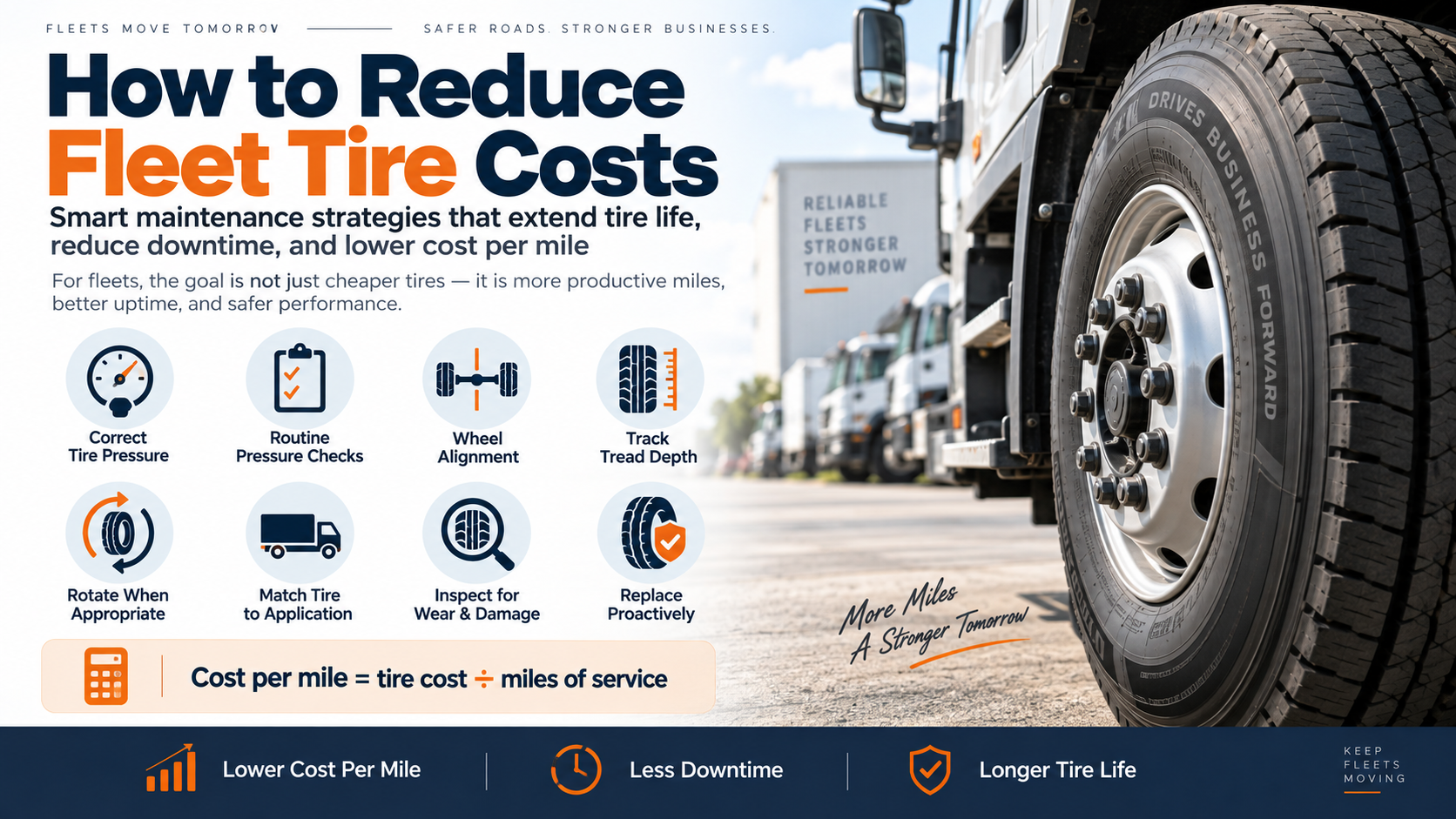
Commercial tires are a major operating expense, but buying the cheapest tire is rarely the best way to lower fleet costs. The largest savings usually come from extending usable tread life, maintaining correct inflation, preventing irregular wear, matching tires to the application, and catching problems before they cause a roadside failure.
For fleets, the right metric is not simply tire purchase price. It is the cost per mile combined with vehicle uptime and safe tire performance.
A $500 tire that reliably delivers 80,000 miles costs less per mile than a $400 tire that must be replaced at 55,000 miles. Add fuel consumption, downtime, service calls, and premature suspension wear, and tire maintenance becomes an important part of overall fleet profitability.
Parker Tire & Muffler works with commercial vehicles and fleet operators throughout Demopolis, Greensboro, Tuscaloosa, and Western Alabama, providing tire and preventive maintenance services designed to keep working vehicles productive.
What Is the Best Way to Reduce Fleet Tire Costs?
The most effective fleet tire cost strategy is to maximize safe miles from every tire by controlling inflation, alignment, loading, rotation, mechanical condition, and replacement timing.
Fleet managers should track more than how much each tire costs at purchase.
A useful basic measurement is:
Tire cost per mile = tire acquisition cost ÷ miles of service
If a $480 tire delivers 80,000 miles, its basic tire cost is 0.6 cents per mile. If a $390 tire lasts only 50,000 miles, its cost rises to 0.78 cents per mile, despite its lower purchase price.
Actual fleet economics can go further by incorporating repair costs, casing value, downtime, fuel consumption, and roadside service.
The objective is not to keep tires in service as long as physically possible. It is to obtain the lowest safe operating cost over the tire’s useful life.
1. Maintain the Correct Tire Pressure
Correct inflation is one of the highest-impact ways to reduce tire cost because underinflation increases heat, rolling resistance, irregular wear, and the risk of tire failure.
A commercial tire carries its load through air pressure. When pressure is too low for the load, the tire flexes more than intended.
Excessive flex generates heat and can accelerate:
- Shoulder wear
- Casing fatigue
- Belt and sidewall damage
- Fuel consumption
- Tire failure
Underinflation also increases rolling resistance. U.S. Department of Energy guidance for light vehicles estimates that fuel economy falls approximately 0.2% for every 1 psi drop in average tire pressure. The exact effect differs for commercial vehicles, but the principle is the same: unnecessary tire deflection requires additional energy to move the vehicle.
For fleet vehicles, inflation targets should be based on the vehicle, axle load, tire specification, and applicable manufacturer load-and-inflation guidance rather than simply inflating every tire to the maximum pressure molded onto its sidewall.
Pressure should also be checked when tires are cold. Do not routinely bleed pressure from a hot tire simply because its pressure has increased during operation.
2. Make Tire Pressure Checks Part of Fleet Maintenance
A fleet tire pressure program works best when pressures are measured on a defined schedule, and abnormal pressure loss triggers an inspection rather than repeated reinflation.
A tire that repeatedly loses air has a problem.
Possible causes include:
- Nail or screw punctures
- Valve-stem leaks
- Valve-core leaks
- Wheel or bead leaks
- Impact damage
- Improperly repaired punctures
Simply adding air every few days treats the symptom while allowing the actual problem to continue.
Vehicles equipped with tire-pressure monitoring systems can provide an additional warning, but a Tire Pressure Monitoring System (TPMS) should not replace regular physical inspections. Parker Tire & Muffler provides TPMS service when sensors, warning lights, or tire-pressure monitoring problems need attention.
For larger fleets, recording pressure by tire position also makes recurring leaks easier to identify.
3. Fix Alignment Before It Destroys Good Tires
Even a relatively small alignment problem can scrub usable tread from a commercial tire long before the tire would otherwise need replacement.
Toe and camber problems can create rapid irregular wear. A truck may still drive well enough that the driver does not immediately notice anything wrong, even as the tires continuously scrub against the pavement.
Warning signs include:
- Feathered tread
- One-sided shoulder wear
- Rapid wear on steer tires
- Vehicle pulling
- Off-center steering wheel
- Tires requiring replacement unusually early
Once tread rubber has been worn away, correcting the alignment cannot restore it.
That makes alignment a preventive expense rather than simply a handling repair. Parker Tire & Muffler provides wheel alignment service in Greensboro and Demopolis to correct caster, camber, and toe problems and to identify steering or suspension conditions that contribute to tire wear.
4. Diagnose the Cause of Uneven Tire Wear
Uneven tire wear is evidence of another condition until proven otherwise. Replacing the tire without correcting the cause often results in the replacement wearing the same way.
Alignment is only one possible source of irregular wear.
Commercial tire wear can also be affected by:
- Worn steering components
- Loose wheel bearings
- Damaged suspension parts
- Weak shocks
- Improper inflation
- Wheel imbalance
- Brake problems
- Overloading
- Driving conditions
A recurring tire-wear pattern is valuable diagnostic information.
For example, wear concentrated on both shoulders often suggests prolonged underinflation or excessive loading, while wear concentrated in the center can be associated with excessive inflation for the load and application. Cupping or scalloping may point toward suspension, balance, or mechanical issues.
Routine vehicle inspections can help find those problems before another set of tires is sacrificed.
5. Rotate Tires When the Vehicle and Tire Design Allow It
Rotation can lower tire cost by redistributing position-specific wear before one tire position wears out significantly faster than the others.
Not every wheel position experiences the same forces.
Steer tires handle cornering and steering loads. Drive tires transfer engine torque. Tires on loaded rear axles experience different stresses from tires on lighter positions.
When appropriate for the vehicle and tire configuration, rotation can distribute wear patterns and increase the set’s usable lifespan.
Rotation intervals should follow the vehicle, tire, or fleet maintenance specification rather than an arbitrary universal number. Severe-duty vehicles may require inspections and position changes more frequently.
Parker Tire & Muffler’s guide to rotating tires on 4-wheel-drive trucks also explains how drivetrain configuration and directional tire designs can affect rotation patterns.
6. Buy Tires for the Application, Not Just the Price
The lowest-cost tire is the tire that delivers the best combination of mileage, traction, durability, rolling resistance, and reliability for the vehicle’s actual duty cycle.
A tire optimized for long highway runs does not necessarily provide the best value for a construction truck operating on gravel, debris, and jobsites.
Likewise, an aggressive, severe-service tire may provide unnecessary rolling resistance and tread characteristics for a vehicle that spends nearly all of its time on paved highways.
Before choosing a tire, consider:
- Vehicle weight
- Axle position
- Typical payload
- Highway versus local operation
- Stop-and-go frequency
- Gravel or off-road exposure
- Annual mileage
- Weather
- Required traction
- Expected casing and tread life
Parker Tire & Muffler’s tire shop carries passenger, light-truck, commercial, agricultural, and other tire options, allowing tire selection to be matched to how the vehicle is actually used.
7. Do Not Overload Tires
Tire load capacity depends on tire size and inflation pressure. Operating above the tire’s rated capacity creates excessive heat and structural stress that can shorten tire life or cause failure.
Commercial vehicles frequently operate with varying payloads.
A truck that is correctly equipped when empty may place substantially greater loads on individual tires once tools, cargo, equipment, or trailers are added.
The correct tire must have sufficient load capacity for the actual axle load.
For vehicles with highly variable or heavy loads, fleet managers may benefit from obtaining axle weights rather than estimating how much weight each tire carries.
Overloading should never be addressed by simply increasing pressure beyond the tire, wheel, or vehicle’s approved limits.
8. Protect Tires From Mechanical Problems
Tire costs can stem from factors other than the tire itself. Steering, suspension, brake, bearing, and axle problems can all shorten tread life.
A fleet tire program should therefore be connected to the vehicle’s broader maintenance program.
Dragging brakes creates heat. Worn suspension components affect tire contact with the road. Loose steering components can produce irregular wear. Bearing or axle problems can alter wheel position.
That is why tire replacement should include an examination of unusual wear patterns rather than treating every worn tire as normal consumption.
Parker Tire & Muffler provides commercial and general vehicle repair services covering brakes, steering and suspension, electrical systems, maintenance, tires, and related components.
9. Repair Repairable Tires Instead of Automatically Replacing Them
A properly repairable tread puncture can preserve the remaining value of a tire, while sidewall, structural, or otherwise unsafe damage requires replacement.
Commercial vehicles regularly encounter nails, screws, metal, and road debris.
Not every puncture means the entire tire has reached the end of its life.
A tire technician can determine whether the injury falls within an approved repair area and whether the tire has suffered internal damage from operating underinflated.
The important distinction is repairability, not simply whether a leak can temporarily be stopped.
Parker Tire & Muffler provides flat-tire assessment and repair as part of its tire services.
10. Inspect Tires Before They Create Downtime
Scheduled inspections cost less than emergency tire failures because they allow maintenance to occur when the fleet chooses rather than when the tire chooses.
Every tire inspection should look beyond tread depth.
Check for:
- Inflation
- Cuts
- Bulges
- Exposed cords
- Uneven wear
- Foreign objects
- Sidewall damage
- Valve problems
- Cracking
- Abnormal heat or wear patterns
For commercial motor vehicles subject to FMCSA regulations, federal rules establish minimum tire conditions. Under 49 CFR §393.75, front tires on buses, trucks, and truck tractors must have at least 4/32 inch of tread in a major groove, while most other tire positions require at least 2/32 inch.
Those are legal minimums—not necessarily the ideal replacement targets for every fleet. Rain, operating environment, application, and fleet safety policy may justify an earlier replacement.
11. Track Tread Depth Instead of Waiting for Tires to Look Worn
Measuring tread depth over time allows a fleet to calculate wear rate and predict approximately when a tire will require replacement.
Visual inspections are useful, but measurements create actionable data.
Suppose a tire loses 4/32 inch of usable tread over 20,000 miles. Its observed wear rate is:
5,000 miles per 1/32 inch
If the tire has 6/32 inch of usable tread remaining before the fleet’s replacement threshold, the fleet can roughly forecast another 30,000 miles under similar conditions.
Actual wear can vary with operating conditions change, but tracking tread depth makes tire replacement more predictable.
It also exposes outliers. If one vehicle consistently burns through tires substantially faster than similar vehicles, there is probably a reason worth finding.
12. Train Drivers to Report Tire Problems Early
Drivers are the fleet’s first tire-inspection system. Early reporting can turn a minor leak or irregular wear into a scheduled repair instead of a roadside failure.
Drivers should know which conditions require attention, including:
- Low tire pressure
- Pulling or steering changes
- Vibration
- Visible cuts or bulges
- Tire-pressure warnings
- Unusual tire noise
- Rapid pressure loss
- Uneven tread wear
A driver who repeatedly tops off a leaking tire without reporting it prevents the maintenance department from fixing the underlying problem.
Simple inspection and reporting procedures can therefore have a direct financial return.
13. Reduce Roadside Failures, Not Just Tire Purchases
The true cost of a tire failure includes the tire, service call, vehicle downtime, driver time, disrupted schedules, and potentially damaged equipment.
This is why tire cost should never be measured entirely at the invoice level.
A tire that costs $50 less but fails unpredictably can quickly become far more expensive than a higher-quality alternative.
For revenue-producing vehicles, downtime may be the largest expense associated with a tire failure.
Preventing failures through inflation control, inspections, alignment, maintenance, and planned replacements frequently provides greater savings than negotiating a slightly lower purchase price.
14. Replace Tires Proactively—but Not Prematurely
The lowest-cost replacement point is before a tire becomes unsafe or unreliable, but after the fleet has captured as much safe tread life as reasonably possible.
Replacing tires too early wastes usable tread.
Replacing them too late creates safety risks and increases the probability of:
- Blowouts
- Road calls
- Delays
- Vehicle damage
- Poor wet traction
- Compliance problems
Tread-depth records, inspection history, duty cycle, tire condition, and seasonal requirements can help determine the appropriate replacement point.
Federal minimum tread limits should be viewed as absolute regulatory thresholds, where applicable, not as a target every tire should be operated down to.
15. Plan Tire Purchases Instead of Buying Only During Emergencies
Forecasting tire demand allows fleets to schedule replacements, budget expenditures, and compare appropriate tires before a vehicle is disabled.
If tread measurements show that six fleet vehicles will require tires within the next few months, those purchases can be planned.
That is preferable to discovering the need for one vehicle at a time after a tire fails an inspection or leaves a driver stranded.
When multiple replacements create a short-term cash flow issue, Parker Tire & Muffler also provides information on commercial tire financing for fleet businesses.
Financing does not reduce the physical rate of tire wear, but it can allow a business to address necessary replacements rather than postpone them simply because several tire expenses occur at once.
What Should a Fleet Track for Every Tire?
At minimum, track tire position, installation mileage, pressure, tread depth, repairs, removal mileage, and reason for removal.
A simple tire record can answer important questions:
Which tires deliver the lowest cost per mile?
Which vehicles wear tires fastest?
Which axle positions experience the most irregular wear?
How many tires are being removed because they are worn out versus damaged?
If a significant percentage of tires leave service due to irregular wear rather than worn tread, the fleet has an opportunity to reduce costs through maintenance rather than purchasing.
Over time, this information is more valuable than relying on the tire price alone.
Commercial Fleet Tire Service in Demopolis and Greensboro, AL
The best fleet tire program is not about stretching tires beyond safe limits. It is about preventing unnecessary tire consumption.
Correct inflation, proper alignment, appropriate tire selection, regular inspections, mechanical maintenance, and planned replacement can help fleets obtain more productive miles from each tire while reducing unexpected downtime.
Parker Tire & Muffler serves businesses and commercial vehicle operators throughout Demopolis, Greensboro, Tuscaloosa, and Western Alabama with tire services, wheel alignment, preventive maintenance, inspections, and automotive repair for vehicles ranging from light-duty work trucks to heavy commercial vehicles.
Lower tire cost should never require accepting lower safety standards. In a well-run fleet, safety and cost control usually point toward the same practices: maintain tires correctly, identify abnormal wear early, and replace them based on condition and data rather than guesswork.